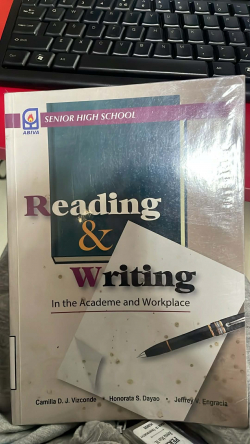
Reading and Writing in the Academic and Workplace

Type
Book
Authors
Category
Faculty
[ Browse Items ]
Pages
499
Description
With the change in the basic education curriculum-the transition from K-10 to K-12-it was imperative to revise existing materials that would be responsive to the changes. In the case of grades 11 and 12, however, revision was not the answer but the creation of materials that would provide continuity from the ten years to preparation for tertiary education or the world of work. Grades 11 and 12 should prepare students like you to pursue higher education in a college or university or to be prepared for work or occupation.
Reading and Writing in the Academe and Workplace is a worktext, which means it provides reading materials and exercises that will enable you to obtain and retain information, comprehend and analyze information, and practice your reading and writing skills. The book is divided into two units: Reading and Writing in the Academe and Reading and Writing in the Workplace.
Reading and Writing in the Academe provides reading and writing resources that focus on skills that you will need if you intend to pursue college education. As Jean Chall proposes as one of the stages of reading development, you have reached stage 4, also known as multiple viewpoints, and this means you can analyze texts critically and comprehend them in multiple points of view. This will prepare you in meeting the next stage in reading for college which is Stage 5: Construction and Deconstruction. It is possible that you may also have reached stage 5 even without stepping yet into the tertiary level as long as you learn how to read selectively, form your opinion about what you read, and construct or deconstruct knowledge from others. This is the highest point of your reading development.
Reading, nonetheless, must be complementary with writing. Comprehension and critical thinking may only be observed when they are expressed and writing is one concrete form of presentation. In academic writing, you need the following features: audience, purpose, strategy, organization, and style. When you write, you have to consider these features and remember to adhere to traditional conventions of grammar, punctuation, and spelling. More often than not, the language is formal and should always be suited to the nature of the disciplines.
You should be familiar with the language of the discipline which is why the lessons for this unit are divided into three major clusters: Reading for the Industry, Reading for Wellness, and Reading for the Arts. Reading for the Industry includes topics in business, management, and commerce. Reading for Wellness includes topics in health and some statistical information about well-being. Reading for the Arts includes topics in literature and humanities.
Reading and Writing in the Academe and Workplace is a worktext, which means it provides reading materials and exercises that will enable you to obtain and retain information, comprehend and analyze information, and practice your reading and writing skills. The book is divided into two units: Reading and Writing in the Academe and Reading and Writing in the Workplace.
Reading and Writing in the Academe provides reading and writing resources that focus on skills that you will need if you intend to pursue college education. As Jean Chall proposes as one of the stages of reading development, you have reached stage 4, also known as multiple viewpoints, and this means you can analyze texts critically and comprehend them in multiple points of view. This will prepare you in meeting the next stage in reading for college which is Stage 5: Construction and Deconstruction. It is possible that you may also have reached stage 5 even without stepping yet into the tertiary level as long as you learn how to read selectively, form your opinion about what you read, and construct or deconstruct knowledge from others. This is the highest point of your reading development.
Reading, nonetheless, must be complementary with writing. Comprehension and critical thinking may only be observed when they are expressed and writing is one concrete form of presentation. In academic writing, you need the following features: audience, purpose, strategy, organization, and style. When you write, you have to consider these features and remember to adhere to traditional conventions of grammar, punctuation, and spelling. More often than not, the language is formal and should always be suited to the nature of the disciplines.
You should be familiar with the language of the discipline which is why the lessons for this unit are divided into three major clusters: Reading for the Industry, Reading for Wellness, and Reading for the Arts. Reading for the Industry includes topics in business, management, and commerce. Reading for Wellness includes topics in health and some statistical information about well-being. Reading for the Arts includes topics in literature and humanities.
Number of Copies
1